
Phototherapy for psoriasis is a family of light-based methods, and the names inside it are not interchangeable. A PubMed Central review says: "recent advancements have been made in developing safe and effective targeted phototherapy modalities for difficult-to-treat areas such as scalp psoriasis."
The terms being set side by side
Two terms stand out. Targeted phototherapy is the first, and the excimer laser is the form of it that the review names. Narrowband UVB is the second, and it has its own PubMed Central study, Narrowband UVB treatment is highly effective and causes a strong reduction in the use of steroid and other creams in psoriasis patients in clinical practice.
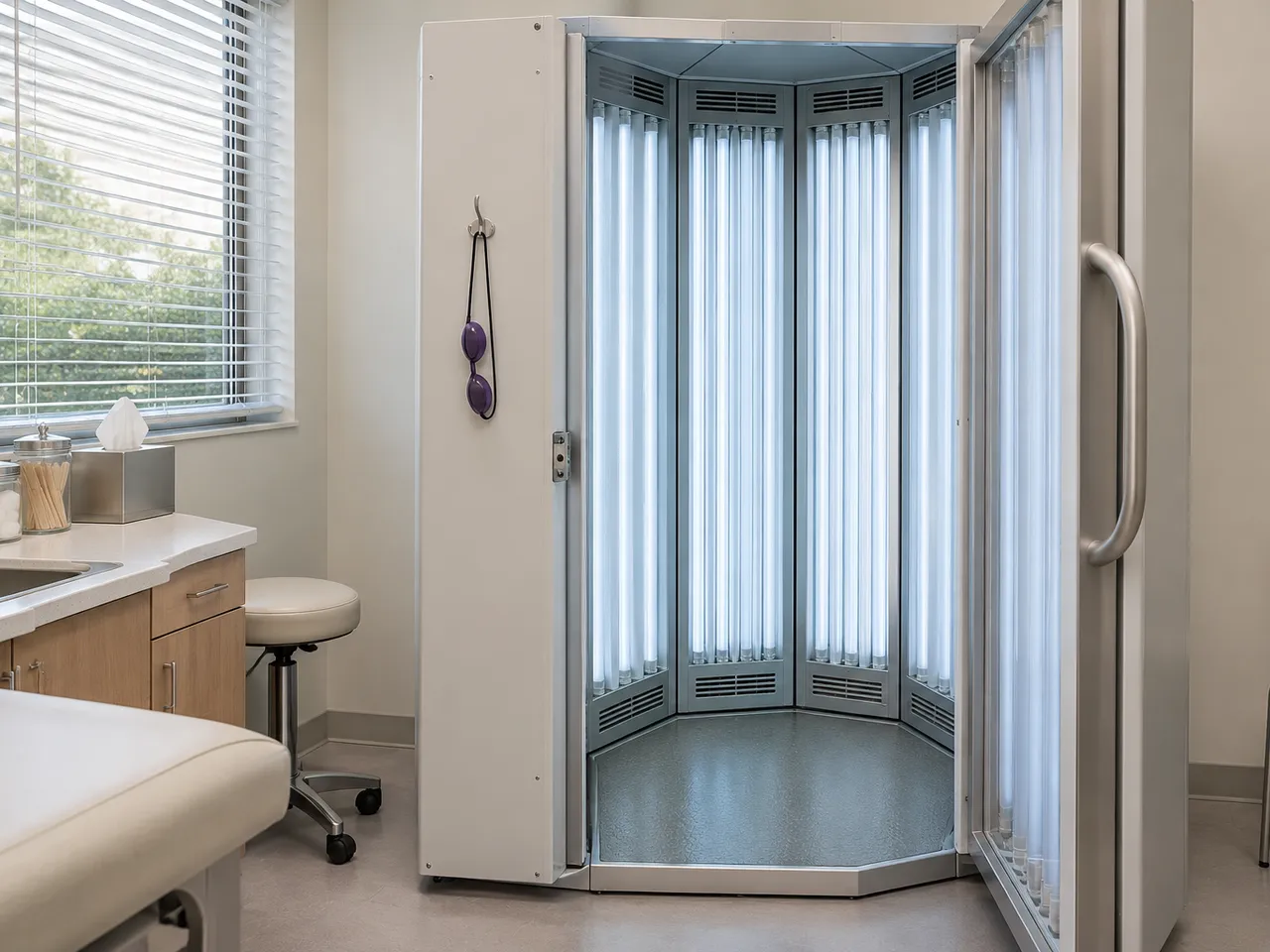
One detail at a time
The first detail is where the treatment aims. The review ties targeted phototherapy to difficult-to-treat areas such as scalp psoriasis. A reader whose psoriasis sits in such an area should read that sentence as written for them.
The second detail is what the review says about the excimer laser: "Targeted phototherapy in the form of the excimer laser holds potential for more aggressive, effective treatment and long-lasting remission of psoriasis."
Where a label says more than the evidence
The sentence says "holds potential". That is a statement about what may come, not a result. The words "long-lasting remission" are tied to that potential and should not be read as a promise.
The phrase "safe and effective" in the first quote is also the review's own description of recent work. It is worth reading alongside a wider review such as Therapeutic Advances in Psoriasis: From Biologics to Emerging Oral Small Molecules, which places light treatment among other choices.
The detail that decides
The deciding detail is whether the area being treated is one the targeted methods were developed for. For wider comparisons, the psoriasis treatment options page and the How Biologics Work for Psoriasis page sit alongside this one.
What to ask a dermatologist
Ask whether your psoriasis is in an area where targeted phototherapy is used. Ask which named method is being offered and how it differs from narrowband UVB.